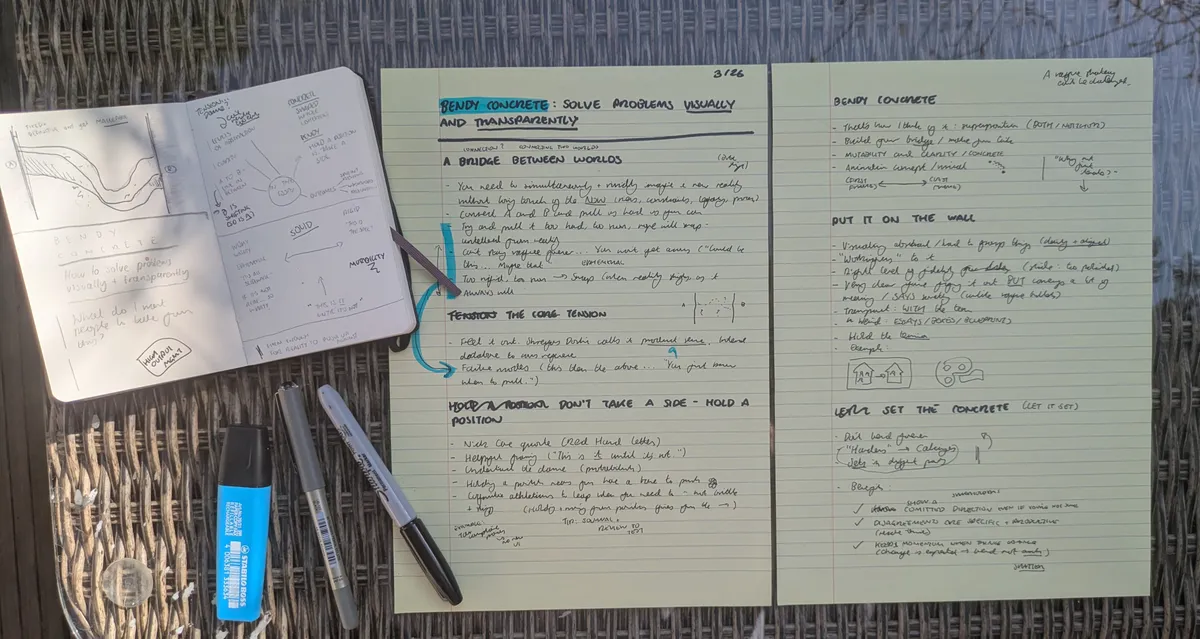
Bendy concrete: solve problems visually and transparently
A bridge between worlds
Product teams have a tricky job.
You’ve got to vividly imagine a future world (how your thing will work, who it’s for, what problems it solves, how it fits into your user’s day to day) while simultaneously keeping the reality of the now in sharp focus (the constraints of legacy systems, governance boards, release cycles, data migrations, workarounds and shadow IT, organisational transformation).
Your job is to draw a line between where you are and where you want to get to - and pull.
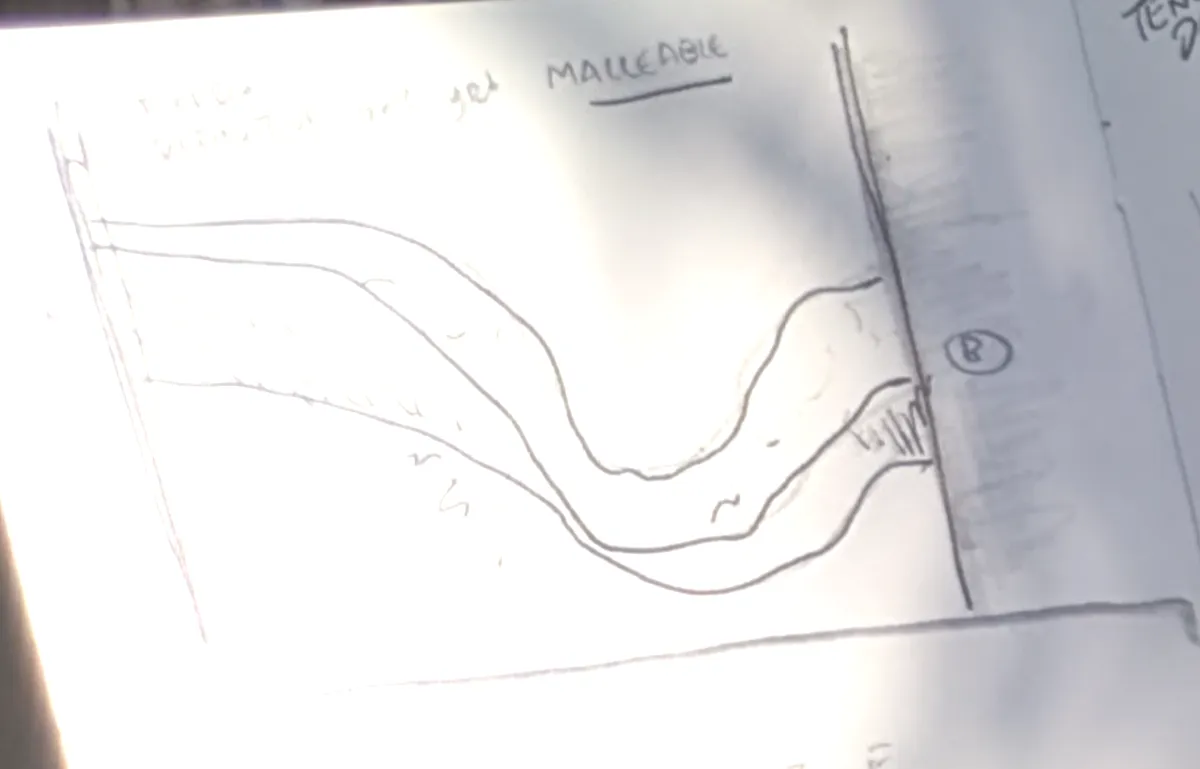 Draw a line from A to B
The core tension
But knowing how to pull, when to pull, and even what you're pulling towards are rarely simple.
Your feet can be too firmly planted in what's happening now. That leads to constrained thinking - the classic faster horses scenario. You end up just digitising steps in the current process, instead of any kind of real transformation. Or, you might get wrapped up in the beauty of your imagined utopian future - and fail to chart a viable course there.
You might struggle to decide entirely. That keeps your vision comfortably vague and ephemeral, but with nothing tangible enough for your team to act on - or your stakeholders to understand. You could solidify your ideas too soon - false certainty - and bulldoze your way through. This will work, until of course it all falls apart when things inevitably change.
Knowing when and how to pull is not an exact science.
Over time, you'll build up an internal database of your experiences to cross-reference. You'll start to implicitly know when it feels right - what Shreyas Doshi calls product sense.
Don’t take a side - hold a position
Musician and writer Nick Cave talks about a broad array of difficult topics (politics, grief, family) in his acclaimed newsletter, The Red Hand Files. When asked how he navigates these murky waters, he says he typically “holds a position, rather than taking a side”.
This is a very useful frame for building your bridge. It’s an acknowledgement of the situation you’re in. Rather than buying fervently into one plan that must be true, you’re simply saying “This is it right now - until it’s not.”
Crucially, you’re also not hand waving and refusing to decide. In fact, it's far easier to move forward. You now have the clear understanding you are simply occupying a position for a period of time. You’re not banking your whole identity on having to be right forever.
Holding a position gives you a stable base to push off.
This kind of mentality, however, does require a degree of cognitive athleticism. It’s very easy to pick a side, and that’s it - you don’t need to look for new evidence, or challenge yourself, or reason things out. It's much harder (but in my opinion more rewarding) to lean into the concept of constant change.
I’ve found reviewing my notebooks (once a month or once a quarter) has helped me calibrate my decision making. You can sense-check your past self's thinking. What exactly did you think? Why did you think it? What actually happened? This sort of honest review is an excellent way to recursively improve the positions you take.
Bendy concrete
Let’s get back to the bridge you're building, and what to build it with. I think the perfect material is something like bendy concrete. It must be substantial and real - yet malleable and mutable. It can't in any way be wishy washy or ephemeral.
Bendy concrete allows you to establish a kind of superposition. This is a concept in quantum physics where something can simultaneously inhabit two states. You want the future you’re building to be just as true and vivid as the reality you're moving away from.
It's exactly the same as the kind of backward induction needed in animation, where you draw the first frame, then the last. From there, you work out a smooth flow of steps between. You're iterating with purpose towards an end state - not just moving and hoping.
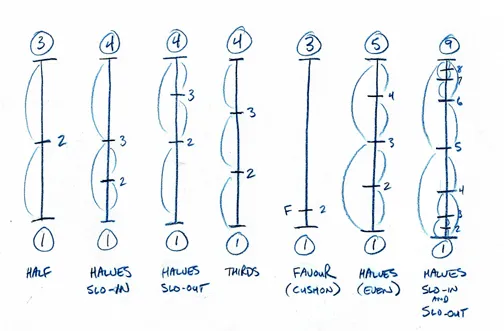 Animation timing chart, Brian Le May
A bridge built with bendy concrete gives you a clear and realistic path from where you are to where you're going.
Put it on the wall
You can't build the bridge alone. You need to do it with your team, and that can be a challenge. There’s a huge amount of information held in everyone’s heads - from data structure to error messaging, from the tech stack to your Jira board, and everything in between.
I’ve found aligning around scrappy drawings - I sometimes jokingly think of them as ‘Hart’s hieroglyphics’ - is the best way to sharpen up collective understanding of exactly what we’re trying to do.
Sketches just have the right level of ‘working-ness’ to them. They are clearly an idea that's being developed, rather than a polished architectural diagram that can’t be challenged. But they are a proper idea - not just a vague concept. They instantly say a lot, without any level of assumed knowledge.
Solving problems visually means drawing them out and making your thinking visible at an appropriate level of fidelity (e.g. shaped, bounded, but not detailed. Solving problems transparently means doing it together, in the open - with your team, with your stakeholders, and perhaps with your users, too.
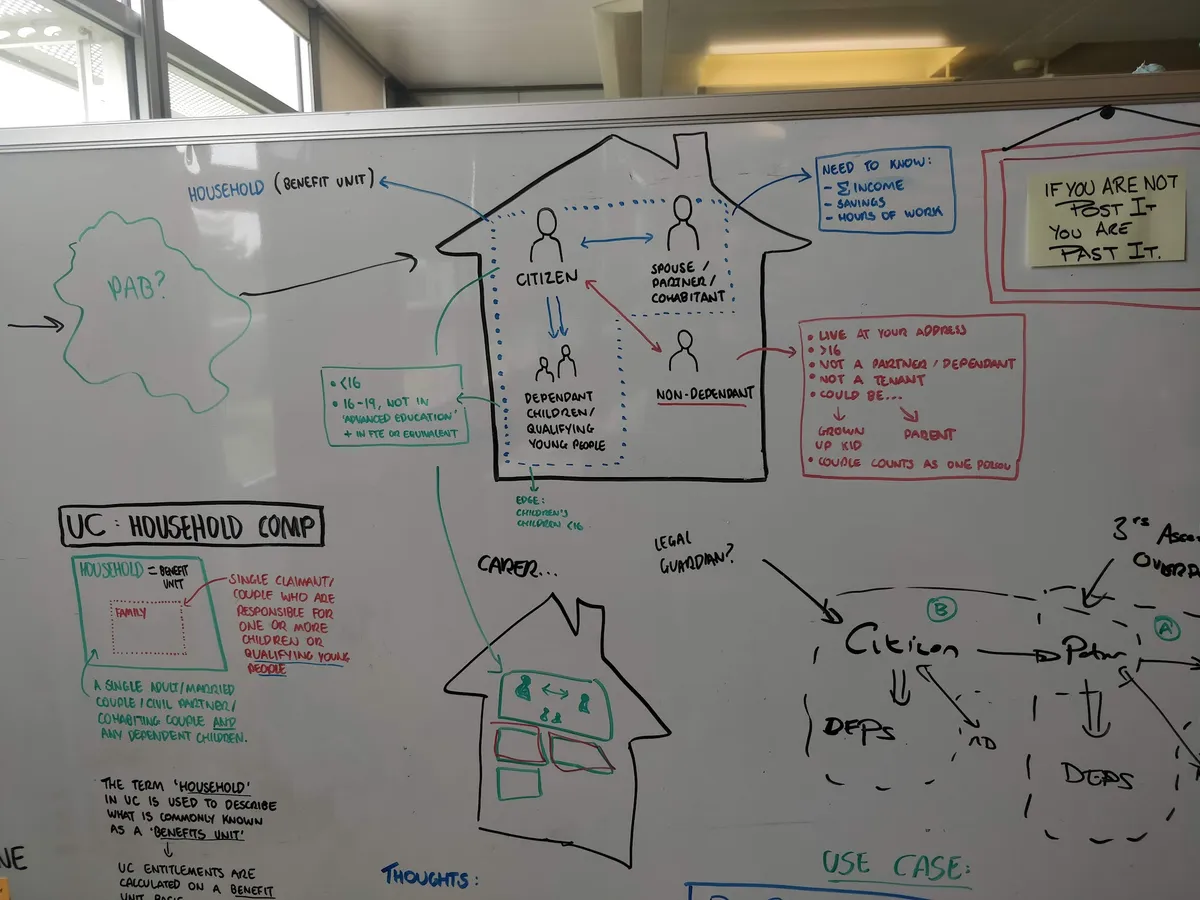 A physical household illustrating relationships in a data model
The best part about these drawings is their extensibility. You can annotate them, include them in documents, as standalone slides, put them together on a whiteboard, and / or refine them into more polished artefacts over time.
Let the concrete set
Bendy concrete isn't supposed to stay bendy forever. The point of all this is to get to a place where it can harden.
Your bridge will almost certainly firm up in different places at different times. The choices you make might mean you then have to go down a certain path - but that kind of reasoned decision making is precisely the point of product work.
So, what does working in this way give you?
You can show a committed direction even when things are unclear. You don't just say "I don't know" or dance around the issue with stakeholders. It makes disagreements specific enough to be productive. Perhaps for the first time, you allow people to inhabit a shared reality. Even if the model you've drawn is completely wrong, you can find a way to make it right, together.
And, perhaps most importantly, solving problems visually and transparently will help you and your team keep going when things change. If you make it bendy from the get go, and build in mutability... Your bridge will flex, not shatter.