First, fix the sewers: administrative leverage and why it matters
Who wants to be an administrator?
On the face of it, administration doesn't sound particularly exciting or fulfilling. To be honest, it sounds like the sort of thing you might start your career doing: filing things, scanning documents, processing invoices…
Designers, engineers, managers, and leaders may be thinking, "Admin? Well, that's someone else's job. Not for me." Deep down, many of us might secretly think that kind of trivial work is somehow beneath us.
I recently finished reading Lee Kuan Yew's incredible memoir on building Singapore, From Third World to First. In the book, he sets out in explicit detail how he and his cabinet went about their work. In 1965, Singapore was an isolated trading outpost; an island with no natural resources. It was effectively forced out of Malaysia, then abandoned by the British.
Just a few short decades later, Singapore had become a thriving, high-income, high-tech city state - the envy of much of the Western world, let alone regional competitors.
While the book contains plenty of geopolitical intrigue and compelling speeches, I was taken aback by how hands-on and practical it all was.
It's nuts and bolts stuff:
- Fixing the sewers and public sanitation (before thinking about vanity projects)
- Zoning laws and regulations for modern housing
- Effective recruitment and performance management
- The specific financial vehicles and instruments for welfare reform
- Establishing a robust curriculum for a population that didn't share a common tongue
It made me rethink the concept of administration completely.
Administration is not busy work. It's answering the question, "How do I marshal the resources at my disposal to make the things I want to happen, happen?"
But everybody wants to "work on the strategy" because it sounds cool - and nobody wants to fix Jira.
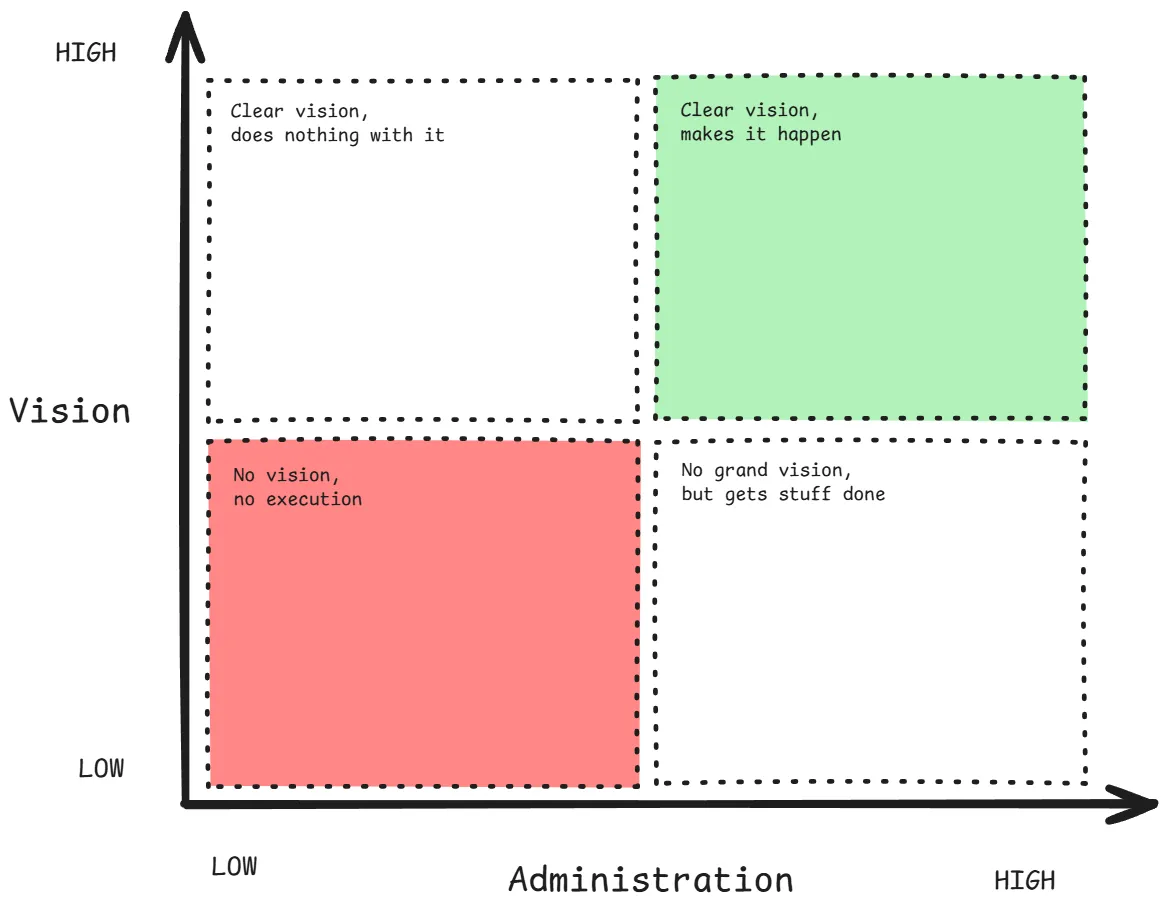
It turns out actually doing sensible things that move you in the right direction is a FAR more effective way to realise your strategy… than locking yourself in a room thinking about strategy.
First order, then brilliance
15th century Florence is known as "the Cradle of the Renaissance". A sudden explosion of creativity, culture, architecture, innovation, art: Michelangelo's David. Botticelli's The Birth of Venus. DaVinci's frescoes.
Why there, and why then? Perhaps it's something to do with double-entry bookkeeping.

For the non-accountants out there, that just means you keep track of the 'in' and the 'out' flow for all financial transactions. Everything remains balanced, and all of a sudden you have a complete picture of the health of a business.
Sounds simple - but it was revolutionary. Before this elegant, technical accounting principle was introduced, cooking the books was simple, fraud was rife and it was hard to build the type of solidity and trust required for complex networks of businesses to flourish.
This deceptively simple bit of administration enabled the rapid evolution of a much more developed ecosystem. Boring, dependable, order - and financial pipework - created the environment for creativity to flourish, and brilliance to emerge.
I think this is a useful concept for product teams: it's very hard to ship great work in a chaotic mess.
- It's hard to understand user needs if your research findings and experiments are poorly organised.
- It's hard to make good decisions if nobody knows where decisions live and what's come before.
- It's hard to make a simple API change if your documentation is two years out of date.
The creative work - the interesting work - happens on a foundation of order. And the better organised you are, the more leverage you create.
Building administrative leverage

Give me a place to stand, and I shall move the earth. Archimedes
Leverage is the concept that a relatively small force applied with a sufficient 'lever' can move a much, much heavier load. The further down the lever you go, the more force you create.
Administrative leverage is that concept applied to organisation.
It starts with focused attention. You should think carefully about improving the actual process of how work gets done, instead of just doing the work as it emerges. It's fundamentally about building the things that make work easier. Every single bit of administrative leverage you create is a small bet on your future being slightly easier, one step at a time.
Some ideas for what that might look like on your team:
Onboarding infrastructure:
- Structured welcome emails for new starters, so they're not sat staring at a Slack thread with no clue who's who and what's going on
- Automated permissions and access to tools, files etc sequenced in the right order
- Well-written context dumps new starters can read in an afternoon, that primes them to hit the ground running
Communication design and information architecture:
- Folder hierarchies that make sense (not just 'ending up like that' through carelessness and entropy)
- Well-maintained Slack resources tabs
- One frequently updated place where key decisions live
- Defining how and where you actually talk to each other as a team
- A bank of docs and slides of a standard format / design system so you don't need to create collateral from scratch
Meeting systems:
- Sprint reviews that essentially run themselves, with a consistent, predictable format your stakeholders can rely on
- Extensible stakeholder collateral you can reuse (project context / vision / as-is / architecture / roadmap / painpoints / key data)
- Actually deciding how meetings should work, instead of winging it
Project infrastructure:
- A clean, clear and logical Jira with proper tagging and releases and epics (this is not unachievable - you just need to grab it by the scruff of the neck and stay on top of it)
The most effective teams aren't the ones that spend the most time on strategy. They're the ones where everyone knows what they're doing, where to find things, and how decisions get made.
Find weak spots in the hull
How do you find these leverage points in your context?
Look and listen for the repeated questions. The things that get asked every standup. The documents that don't exist, but should. Look for the handoffs between roles and teams that don't work, or feel clunky. Pay attention to the meetings where people's cameras flick off and… drift into nothing. The decisions that get made, remade and misunderstood.
Ask yourself:
- What would make this better?
- What are the practical, simple things I could do right now to make that better outcome more likely?
You don't need to redesign everything. Start with just one small thing and get the ball rolling.
Fix the onboarding email, or tidy a particularly egregious section of Jira up. Archive a four year old dead Confluence page that confuses everyone. Have a think about a consistent framing for your sprint review.
Small, boring, inconsequential… until they're not.
You'd be amazed how five small improvements like that, compounded over time, can set you on a completely different flight path. In contrast, five months just thinking about strategy will get you precisely nowhere.
And it gets easier as you go. Like Archimedes moving down the lever, it takes less and less effort to get to better and better outcomes.
Reclaiming administration
Being an effective administrator used to be a badge of honour. Perhaps it should be once more.
We're all administrators whether we like it or not. The choice is whether we take that sort of work seriously or think it's beneath us. Whether it's organising your folders, or fixing the sewers… Getting the boring parts right, matters.
Because nobody's painting a masterpiece if they're knee deep in shit.