Product is probabilistic
Can you predict the future?
Most lines of work involve some kind of prediction.
A film producer might reason "There's an appetite for a new Superman film, and it'll generate more than $500b", which convinces studio executives to undergo the huge effort of bringing it to life.
A maize farmer could think "Our crop will flourish if we can just deal with our aphid problem", and focus their efforts on eradicating the threat.
The reason this is important is because of opportunity cost. Based on what you think is going to happen, you make a bet about how to spend your time, energy and effort.
Instead of the Superman film, you could make two thrillers and a rom com which collectively do far better. You could eradicate the aphid problem, then realise it was birds eating the seed all along.
More than a guess
Thankfully, I'm not making decisions about blockbusters or crops. The types of prediction I might need to make as a product manager are things like:
- "We think shipping this new feature will increase adoption."
- "Simplifying this flow will reduce churn."
- "Handling this nasty piece of tech debt will speed up releases and reduce cost."
- "Integrating with this service will ultimately save user time".
There are many types of predictive models, designed to help you figure out what's going to happen next. Two of the better-known are deterministic and probabilistic.
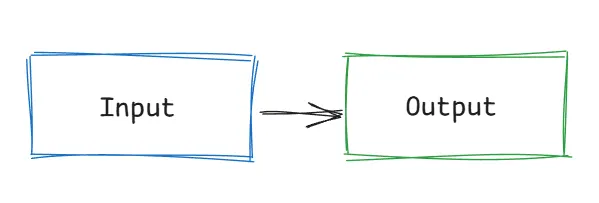
A deterministic model loosely means that given the same inputs, and the same approach, you're going to get roughly the same output every time (you put 20+20 in your calculator and get 40, consistently).
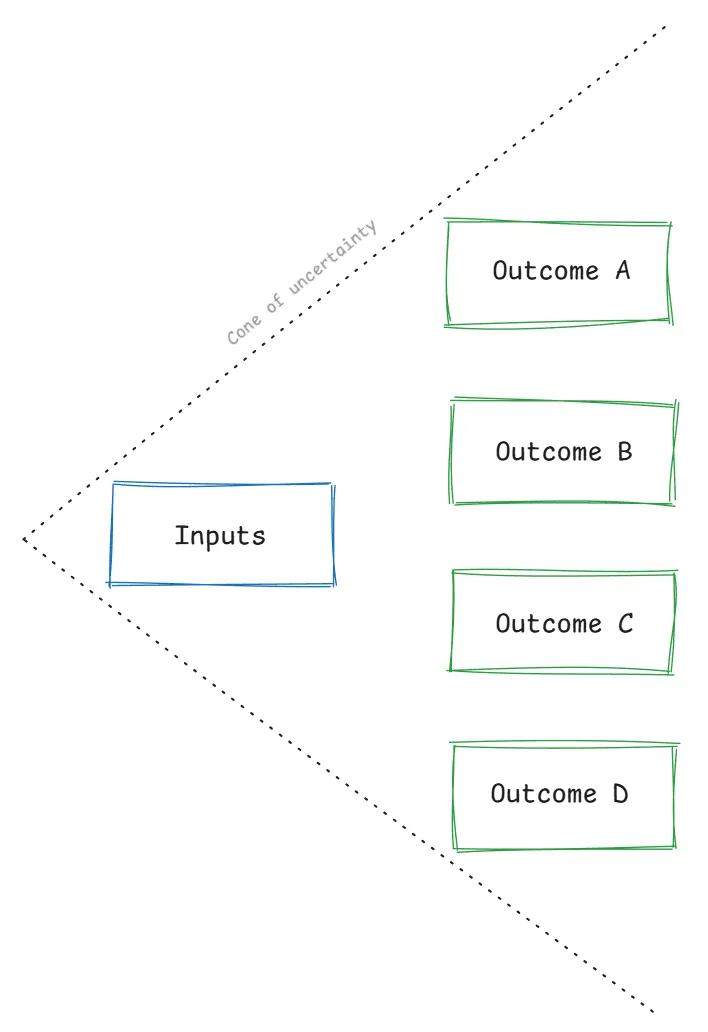
A probabilistic model factors in the element of chance: given exactly the same inputs and same approach, you could get a wildly different outcome (you put 20+20 in your calculator and it transforms into a banana).
Choose the right model
I've found people often have this implicit pattern of thinking that building digital products and services is deterministic.
"Well, we'll stand up a team with these roles in it to figure out this problem. They can do a couple of rounds of research, come up with a prototype, build it, and it'll meet all the user needs and instantly solve this years-old business challenge."
Any kind of project (at least the sort of projects I've worked on) involving digital transformation is typically way too complex for that kind of simplistic model to be useful. There are too many variables, too many unknowns - just too much going on.
No matter how badly we want it to happen, we just cannot know for sure that doing X will lead to Y by date Z.
We don't know if handling our aphid problem will improve the crop. We can't be certain the new film will be a critical and commercial success.
Handling uncertainty
That doesn't mean we should stop trying to figure these things out - it's not totally out of our control. As philosopher Eric Hoffer put it:
"Creativity is the ability to introduce order into the randomness of nature."
Instead of worrying about the perfect prediction or getting caught off guard when things veer of course, I focus on the specific actions I can take to reduce the random element and tighten the 'cone of uncertainty' (e.g. making a given outcome more likely than others):
- Controlling the controllables. What are the things I can have a direct impact on that give us the best chance of succeeding?
- Actively managing risks. Calling out the things I'm worried about, be explicit about the impact, clearly express them to the team and stakeholders - and most importantly, try and do something about them.