SIGNAL
A practical, visual guide for getting your ideas into the world - because your ideas are only as good as your ability to communicate them.
You can read it in full below, download a free PDF, or buy the paperback on Amazon.
Contents
Use this book to tackle your communication struggles. You can read it start to finish, or focus on solving specific problems.
Preface
I spend a huge chunk of my day communicating. We all do.
Whether it's asking your stressed partner about their day without making it worse, trying to get your kid to actually eat their Weetabix, making small talk with an awkward acquaintance at a wedding, pitching an idea to bored and distracted colleagues at work, or negotiating the price of your next car with a determined salesperson...
Communication runs through nearly all human activity.
I first started thinking about this book during the COVID-19 pandemic. I remember watching the press conferences, and thinking about how poorly some of the ideas came across.
Chaos, confusion, and mixed messages — at a time people really needed clarity and a sense of direction. It suddenly became incredibly clear to me: your ideas are only as good as your ability to communicate them.
We live in a world of exhausting emails, confused messaging, and long-winded speakers. Your ability to communicate effectively remains a real opportunity to get things done much faster than your peers. And in 2026, that advantage compounds: AI is advancing at blistering pace. Everyone's talking about it replacing — or at the very least, drastically changing, human jobs.
But communication is the one skill AI makes more valuable, not less. The better you articulate what you want, the more you can leverage every AI tool at your disposal. Vague prompts will get vague, mediocre results. Clearly expressed thinking gets extraordinary output.
Computer scientist Fei-Fei Li said it perfectly: "The future of artificial intelligence is not about man versus machine, but rather man with machine."
That partnership hinges on your ability to communicate. Which is why this book — which I started writing years before AI became ubiquitous — matters more now than ever. Communication is one of the most valuable and future-proof skills in the modern world. One well articulated idea can change your whole life.
The premise behind this book is that becoming a formidable communicator isn't something defined by your DNA or your upbringing.
Communication isn't magic. It's just a bundle of skills. Skills that can be broken down into parts, learned, practiced, and applied to your life with basically no barrier to entry. The book contains 23 short, practical ideas split into three sections:
- Empathy helps you connect with your audience and see the world from their perspective. You can't make yourself understood if you don't understand who you're speaking to.
- Reason helps you figure out exactly what you're trying to say. Most communication fails because people haven't thought clearly enough about their message before trying to deliver it.
- Clarity helps you package your ideas so they are clear, compelling and coherent, so they cut through the noise.
Together, they form a simple framework anyone can pick up and use to become a better communicator almost instantly. This book is for anyone interested in how ideas get into the world, and wants to do it more effectively.
I'm a big believer that a world full of better communicators can only be a good thing. So, whoever you are, I hope you find it useful.
— Joe Hart, West Yorkshire, February 2026
Part 1: Empathy
Empathy is the ability to put yourself in someone else's shoes. It's how you start to see the world from the perspective of another human being.
How does it tie into communication? Because to make yourself understood, you first have to understand.
Theoretical communication doesn't exist: it's something you do with others. And that means understanding that everyone experiences the world differently. Building empathy is a non-negotiable for truly effective communication. Without it, something fundamental is missing: it's like trying to give someone directions, without knowing where they stand.
Build a picture
Bad communication is randomly broadcasting your thoughts, without any idea of what you're trying to say or who you're trying to say it to. Communication is about making choices. Imagine cooking a meal that was a curry, a bowl of pasta, a sandwich, and a birthday cake in one: yuck.
If you try to communicate with everyone about everything, you'll end up communicating nothing to nobody.
Clear communication begins by building a picture of exactly who it is you're trying to speak to. How old are they? What do they look like? How do they spend their days? Where do they live?
In a letter to a friend asking for writing advice, John Steinbeck said, "Your audience is one single reader. I have found that sometimes it helps to pick out one person — a real person you know, or an imagined person — and write to that one."
Building a clear, vivid picture of who that person helps you clarify your communication before you get far into the technical details and intricacy of what you're trying to say.
Empathy mapping is a technique from design thinking. It helps you step into your audience's shoes by charting their thoughts, feelings, and pain points.
Here's how you do it:
- Take a blank piece of paper.
- Draw a circle in the middle.
- Now split the page into four sections, and label each section with a different heading: Says, Thinks, Does and Feels.
- Go back to the circle in the middle, and draw the person you have in mind. Write their name underneath.
- Set a timer for 5 or 10 minutes, and fill in your map. Don't filter yourself. Let your ideas flow onto the page. Write quotes (preferably real, but imagined is ok). Be as specific as you can. Think about how they fill their days. Capture their thoughts and underlying feelings. Circle and underline things you think are important.
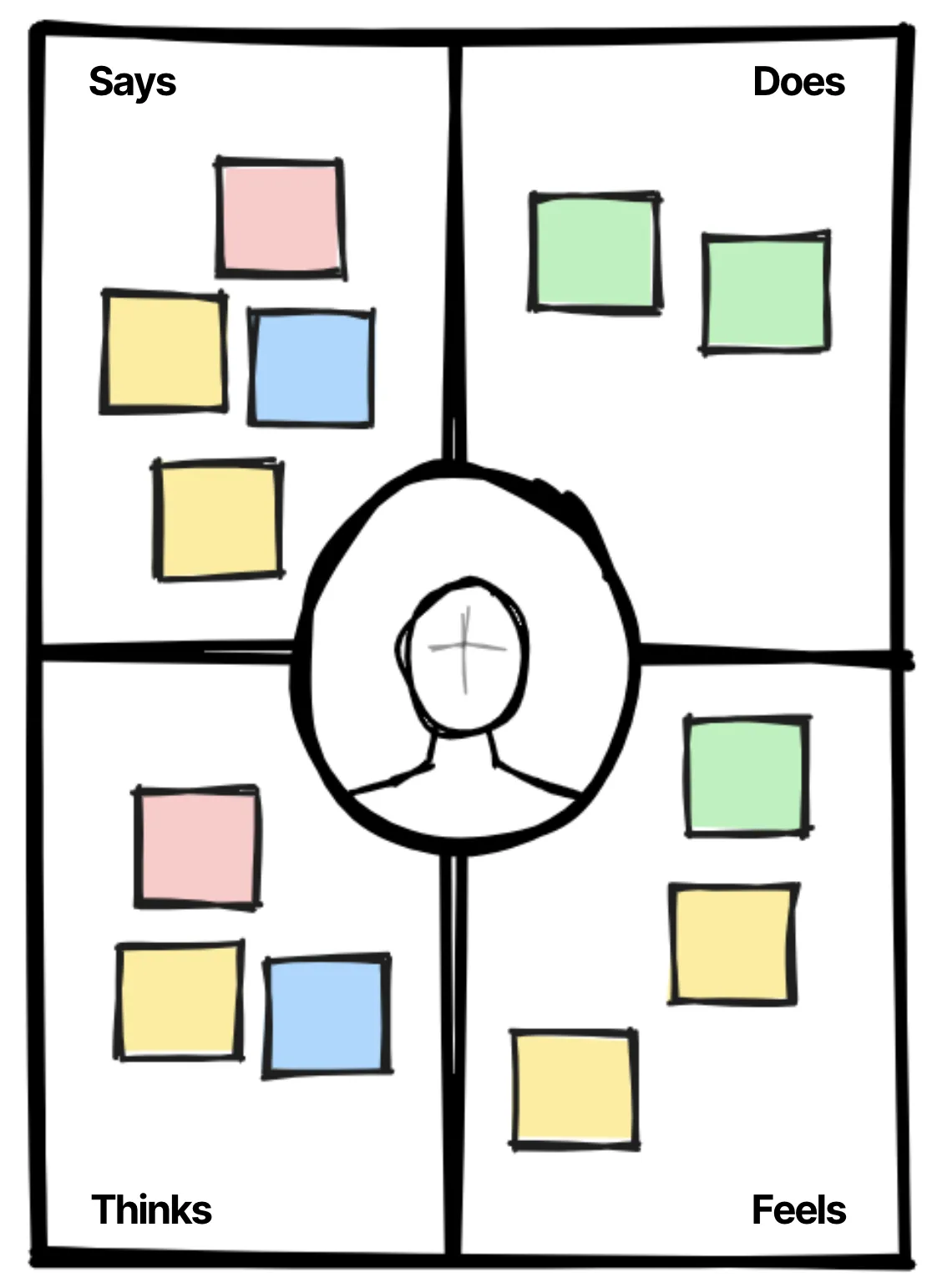
Finally, take a few minutes to consider what you've produced.
Make connections — draw arrows. Stick your empathy map on the wall, or somewhere you'll be reminded of it. Add to it as you learn more, and create new maps when you need to. They'll ensure your ideas resonate deeply with your audience and cut through the noise.
"You never really understand a person until you consider things from his point of view — until you climb into his skin and walk around in it."
— Harper E. Lee
Context is king
Getting your ideas across is a bit like sending a precious parcel.
You have to think about how best to package it up to survive the trip, work out the quickest and most cost-effective way for it to get there — and hope it arrives in one piece.
But even the most thoughtful gift in the world might be poorly received if it arrives on the morning of a funeral.
In August 2017, AirBnB launched a campaign focused on water-themed rentals (like houseboats), with tongue in cheek slogans like "Stay above water". Unfortunately this coincided with the devastating Hurricane Harvey, which caused horrendous flooding and displaced thousands in Texas. Needless to say, the campaign was quickly shelved.
Understanding the context is an essential part of good communication.
Content without context is noise.
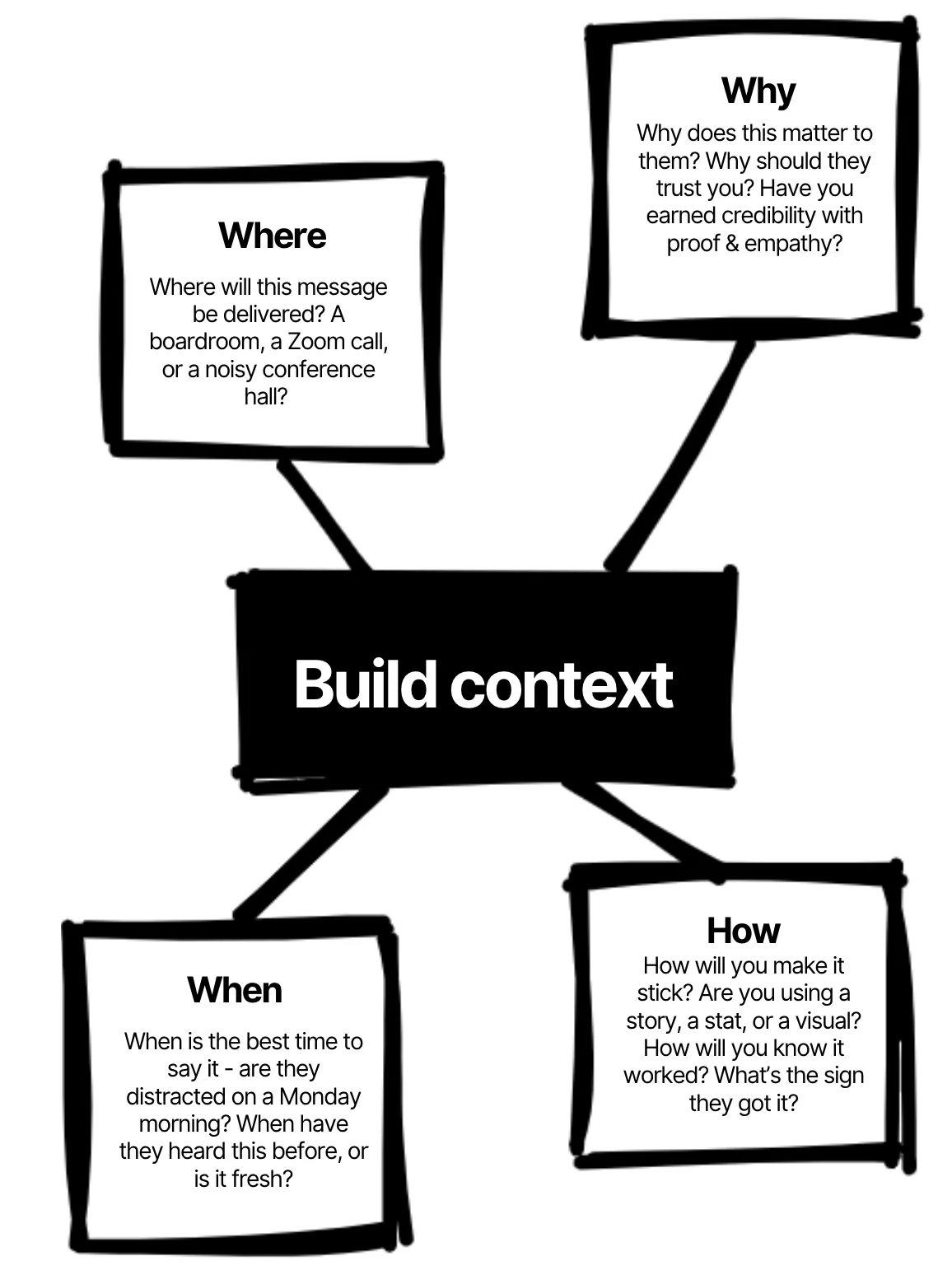
It's not enough to just identify who you're trying to speak to — you need to think about where, when and why too. Some questions to consider:
- Where: Where will this message be delivered? A boardroom, a Zoom call, or a noisy conference hall?
- When: When is the best time to say it — are they distracted on a Monday morning? When have they heard this before, or is it fresh?
- Why: Why does this matter to them? Why should they trust you? Have you earned credibility with proof & empathy?
- How: How will you make it stick? Are you using a story, a stat, or a visual? How will you know it worked? What's the sign they got it?
Mind the listening gap
Your brain is an incredibly powerful processing machine. The average person:
- Speaks 150 words a minute
- Reads 200 words a minute
- Thinks 800 words a minute
These numbers show how easy it is for communication to fail, falling into this 'listening gap'.
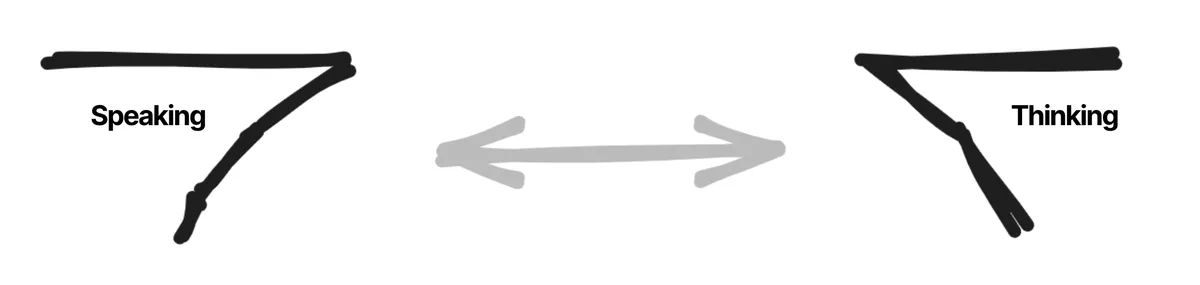
There are a huge number of opportunities for people's brains to race ahead, to get distracted or bored... Or start thinking about something else entirely.
Tackling the listening gap is at the heart of effective communication. Because if you can't get people to listen to what you're trying to say, it simply doesn't matter how brilliant your idea is.
I've found that rather than get frustrated or annoyed, you just need to accept that people's focus will inevitably wander. Focus your efforts on making it as easy as possible for people to pay attention to what you're communicating.
Simplicity: use simple, familiar language
Research on cognitive load theory (Sweller, 1988) shows that people can process information far better when their working memory isn't overloaded. In essence: use simple language to cut mental strain. This aligns with how people naturally think and speak, which speeds up comprehension.
In modern politics, President Trump is an absolute master of this ("Build the wall", "Make America Great Again", and so on).
Structure: organise your ideas
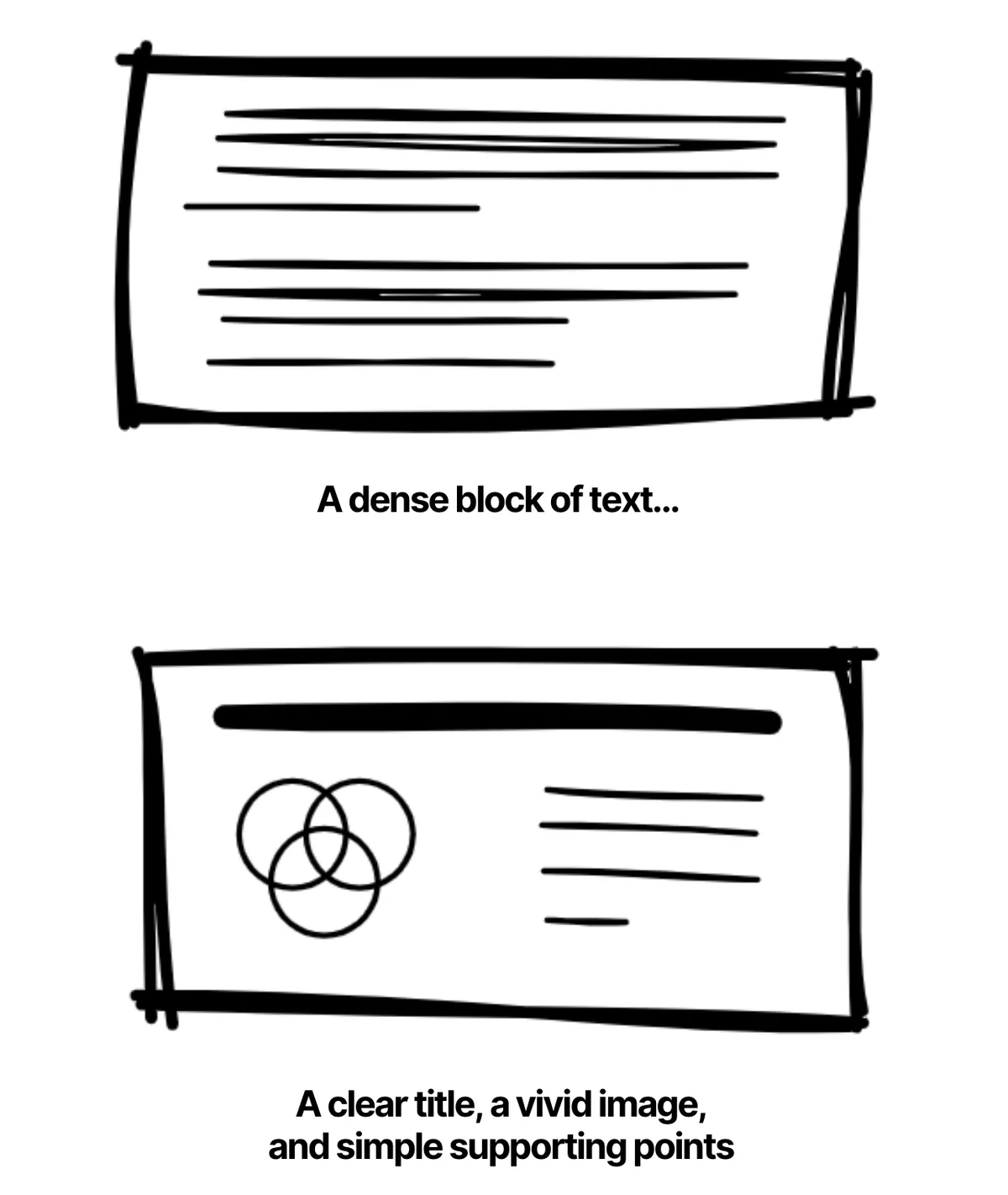
The Flesch-Kincaid readability formulas show that short sentences and well-organised text improve understanding (Kincaid et al., 1975). Breaking information into chunks helps readers process one idea at a time.
This applies to the information age, too: a 2014 Nielsen Norman Group study on web usability confirmed that concise, easily scannable formats boost knowledge retention by up to 47% compared to dense blocks of text.
Visuals: use concrete examples
Abstract ideas are hard to grasp. Using real and relatable scenarios helps them stick. A 2002 study by Mayer and Moreno found students understood scientific explanations 50–60% better when paired with diagrams or real-world examples.
Learn to listen
We all want to make ourselves understood — and to understand each other. Building that kind of empathy is best achieved through listening.
The Greek philosopher Epictetus said, "We have two ears and one mouth, so that we can listen twice as much as we speak."
Good advice: but while it sounds simple, it's not easy. To truly listen is not just hearing what someone is saying or reading what they've written.
- Active listening: Focus is fully engaged with no distractions. Intent is to understand and connect. Response is to reflect, question, clarify. Engagement is two-way. Mindset is open.
- Passive listening: Focus is scattered and multi-tasking. Intent is hearing without processing. Response is minimal — a grunt or slight nod. Engagement is one-way. Mindset is closed.
One builds connection — the other builds nothing.
"I have learned a great deal from listening carefully. Most people never listen."
— Ernest Hemingway
Empathy is a skill
Many people assume there are two types of communicators: those who are naturally talented, and those that aren't. I don't believe that's true — and nor should you. Communication is just a skill (albeit a 'meta-skill' comprising lots of smaller skills) - and empathy is one of the most important components.
As Sir Simon Baron Cohen, the esteemed clinical psychologist and writer, says: "Empathy is a skill like any other human skill. If you get a chance to practice, you can get better at it."
It's a cop-out to assume you either 'get it' or you don't. Nobody leaves the womb able to play a guitar, or ride a bike, or knit a scarf.
You have to learn by doing — again, and again, and again.
Draw empathy maps. Listen. Ask questions. Think deeply. You'll create competence by being consistent over time.
It's very, very easy to blurt out opinions, write an email or deliver a presentation with no thought about who's on the other end. Doing it with empathy is hard. It takes time, it takes effort. But it works — and it's worth it.
Measure twice, cut once
Abraham Lincoln famously said, "When I get ready to talk to people, I spend two thirds of the time thinking what they want to hear and one third thinking about what I want to say."
With the frenetic pace of the modern world, the emphasis in communication often seems to be on speed at the expense of everything else. You've just got to send that tweet now, fire off that email, or blurt out the first thing that comes to mind.
But that's not what effective communicators do.
They organise their thoughts to give their message the best chance of surviving transit. Like any professional — they measure twice, so they only have to cut once.
This doesn't need to be a big ordeal.
At work, I've found simply taking 5 minutes to 'sketch the shape' — whether that's a conversation, a product launch strategy or an email — has the potential to completely transform what you get out of it.
A handy frame of reference is thinking about preparing a communication wireframe.
This is a common practice from UX design, where you roughly block out the key components on a screen or journey to figure out the flow before getting into the detail.
By giving yourself the space to think about what you're trying to say — and who you're trying to say it to — you ultimately save yourself time, effort and energy clarifying things or covering old ground.
A word of warning: it's easy to get stuck in analysis paralysis. This doesn't mean you spend hours wargaming a 2 minute conversation.
Ready, fire, aim.
"A good plan violently executed now, is better than a perfect plan executed next week."
— General George Patton
Vigorous curiosity
Curiosity is the fuel of discovery.
It's how we find new things out, expand our horizons and ultimately, grow our ability to understand the way the world works.
I've observed that the best communicators have a deep interest in the people around them, the world they live in, the obstacles they face and how they navigate through them.
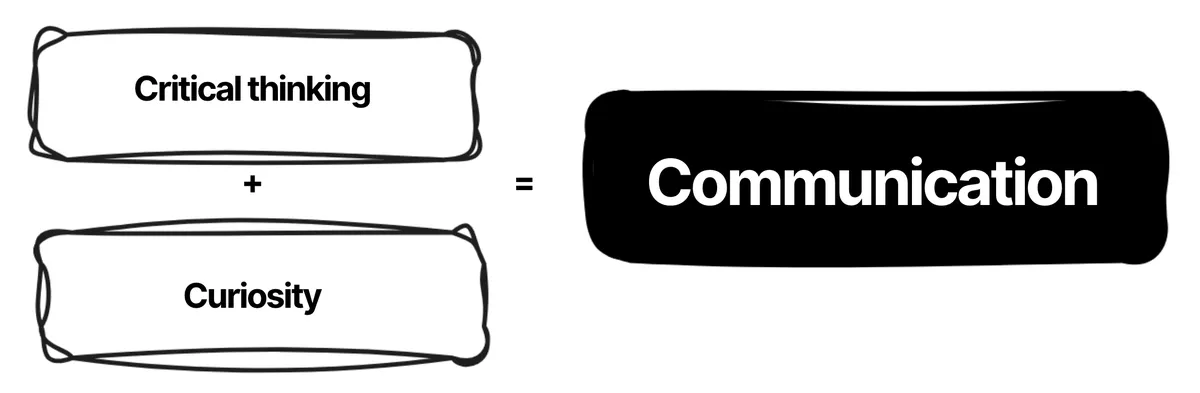
Actress Amala Akanneni said, "Critical thinking and curiosity are the key to creativity." I think they're the key to communication:
A few ideas on how to cultivate a mindset of curiosity:
Ask stupid questions
You never learn anything if you're too proud to look stupid. Every day, ask a question you're scared will make you look stupid: "Why'd you do it like that?" or "What's that made of?". Curiosity pries open souls, and empathy slips in through the crack you've made.
Ask open questions
Don't fish with a hook when you can cast a net — you never know what you'll catch. Curiosity thrives on the sprawl and depth of people's answers. Yes and no answers just shuts things down and keeps you stuck where you are.
Read widely
The author Malorie Blackman says, "Reading is an exercise in empathy; an exercise in walking in someone else's shoes for a while." Simply by picking a random book off the shelf and reading a few pages, you can dive into someone else's mind, and experience a world wildly different to your own.
I remember as a new, sleep-deprived dad, it was the first time in my adult life I barely read at all. I could almost physically feel my brain shrinking. The first book I picked up was The Three Body Problem by Liu Cixin.
Straight away my brain started whirring, thinking about physics, communism, how books are adapted into TV series, and a million other things. It was a fitting reminder that you can simply open the curiosity tap any time you want.
Idea diversity
Feeling empathy for like minded people isn't too challenging.
You can fairly easily understand why they do the things they do, and how they might respond in different circumstances to different forms of communication.
It's much harder to build empathy for those with radically different views to your own. But you can't communicate effectively if you're in a vacuum.
So you need to figure out a way of increasing the diversity of ideas you're exposed to: to make a deliberate effort to reach for an antagonistic idea and grapple with it.
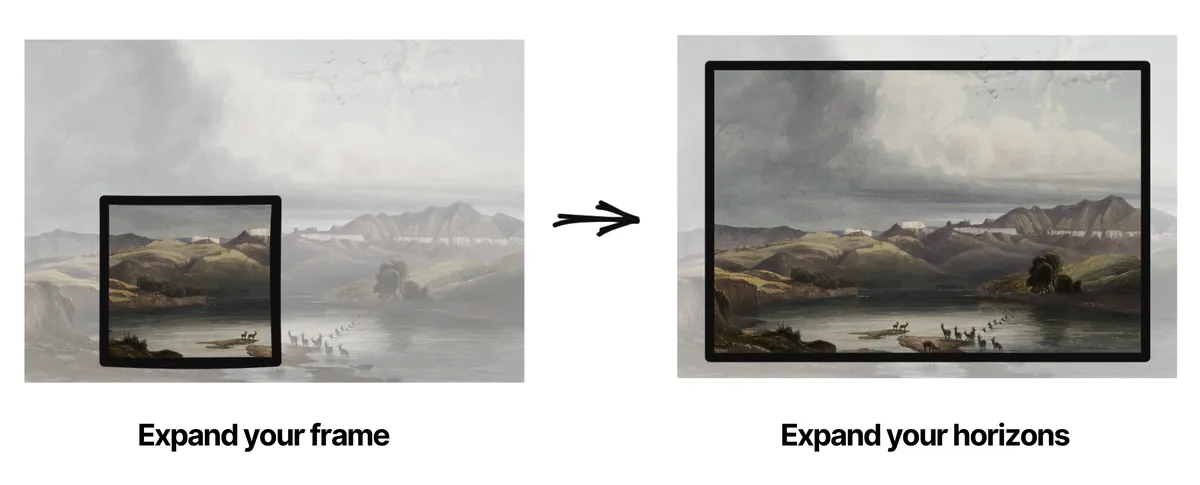
It's a challenge which will make you a much more formidable communicator, able to articulate ideas with tact and nuance.
One way to get there is by steel-manning. Steel-manning is the opposite of straw-manning, where you simplify, misrepresent or gloss over an opposing viewpoint to try and win the argument.
'Rapaport's Rules' are a famous list of principles on encouraging thoughtful debate, from the game-theorist Anatol Rapaport. His first rule is the perfect way to put steel-manning into practice:
"You should attempt to re-express your target's position so clearly, vividly, and fairly that your target says, 'Thanks, I wish I'd thought of putting it that way'."
For reference — the other rules:
- Focus on agreement: Did you highlight points you both agree on — especially if they're not obvious?
- Acknowledge what you've learned: Have you acknowledged something new you learned from their perspective?
- Where do you differ? Now, you can offer your critique.
The tension of clashing ideas creates exactly the right kind of environment for nuanced thinking to flourish.
Key takeaways: Empathy
- Empathy helps you connect with who you're trying to communicate with
- You can use empathy maps to build a vivid picture of your audience
- Don't overlook the context you're trying to communicate in — it plays a huge part
- Remember we think faster than we speak or read: get ahead of it proactively
- Listening without judgement or interpretation is a superpower
- Deliberately practice empathy: it's a skill, and it won't develop on its own
- Take the time to prepare your communication, but don't paralyse yourself through over-analysis
- Stay curious and keep learning: the more you know, the broader your viewpoint
- To feel true empathy, get out of your bubble and tangle with new ideas