Solve for cohesion
I have had this question written down for several years on various post-it notes, which I keep either on my desk, in my current notebook, or on my whiteboard at home: "How will the thing we're working on replace or work with what people currently use?"
Answering that question has proven incredibly useful time and time again on project after project. If I can't come up with a credible, coherent and detailed answer, I know there's more work to do.
Think beyond the brief
To demonstrate why that question is so important, let's work through an example.
Picture your living room. Your brief is to get a new coffee table. So, you have a bit of a look on Pinterest, shop around, and eventually find the one you're after: it looks great and it's the right price.
But, it's just a little bigger than your old coffee table. So you don't need to shuffle around it to sit down, you have to push your sofa back a couple of inches. But now the door won't open all the way, so every day - multiple times a day - you find yourself having to squeeze past it.

If your measure of success is just "replace the coffee table", then great - job done.
You might even be able to justify it to yourself by saying "Well, my brief wasn't to redesign the the whole room, that's out of my scope - I'm just getting a new coffee table."
Thinking about how it all fits together might be beyond the original brief, but that doesn't mean your attempts to solve the problem won't have a knock-on impact.
That crowded living room is often how the digital landscape and experience feels to our users: cluttered, full of minor frustrations and friction that stack up and make it harder to get things done.
Cohesion matters
It's actually quite a simple thing to just bulldoze your way through and ship something, anything - and on its own, it could even work for some use cases.
It's incredibly difficult to ship a new product that solves a problem AND fits. Friction = failure. But, cohesion is what makes products truly successful.
To work out what's going to add to the experience without causing unnecessary issues requires a solid depth of understanding about:
- Who your users are
- What they're trying to achieve
- How they're currently solving their problems
- The constraints they're up against
- What's going on in the wider landscape / other changes
It's a lot of work - and it needs to be taken seriously.
Cohesion is also admittedly a tricky thing to measure. It doesn't fit nicely with some of the more common KPIs you might lean on like adoption or retention (or at least, you can't directly tie cohesion to those things).
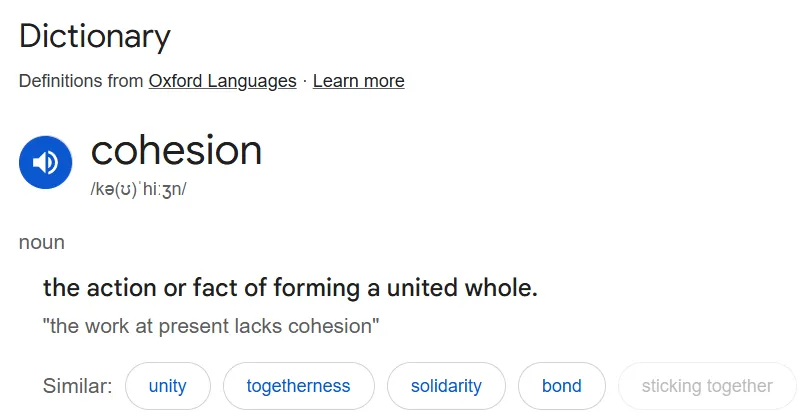
It's simply about things working and feeling joined up as your users go about their day. If you get it right, then it won't even be something they actively have to think about.
In the coffee table example above, the right coffee table would just work with the rest of the room. Your user can just calmly sit down on the sofa with a coffee without squeezing past, or look out the window, or play with their kid, or carry a basket of laundry through the room without bumping into anything or forcing a door open.
Can you create cohesion?
Solving for cohesion is hard, but in my view 100% worth it, and something I spend a huge amount of time and effort on.
Cohesion should at the very least be on the spectrum of explicit and specific outcomes you're trying to reach, rather than something that gets lost in the ether.
So, as you're going about your day today, ask yourself the question: "How will the thing we're working on replace or work with what people currently use?"