The value ladder: how to make sense of what you're building
Every product manager inherits a roadmap eventually. A scrappy spreadsheet of initiatives that made sense to someone, once upon a time. Features that seemed important in a meeting six months ago. Work that's been rolling forward on momentum alone.
Your job is to figure out why any of it matters.
I remember the first time I stared at one of these inherited roadmaps, trying to make sense of the chaos. What connected these random initiatives? How had they earned their place? Why should anyone care?
Admittedly without much strategic foresight, I stumbled on a technique that's stuck with me since. I call it 'laddering', and it's become one of the most useful exercises I know for connecting work to purpose.
Building the ladder
The idea is simple: build a ladder from each initiative on your roadmap all the way up to your organisation's purpose.
Take it one 'rung' at a time.
- Start with an initiative. How does it connect to your product vision?
- Take that product vision. How does it connect to your transformation programme or directorate objectives?
- Take those objectives. How do they connect to what your organisation actually exists to do?
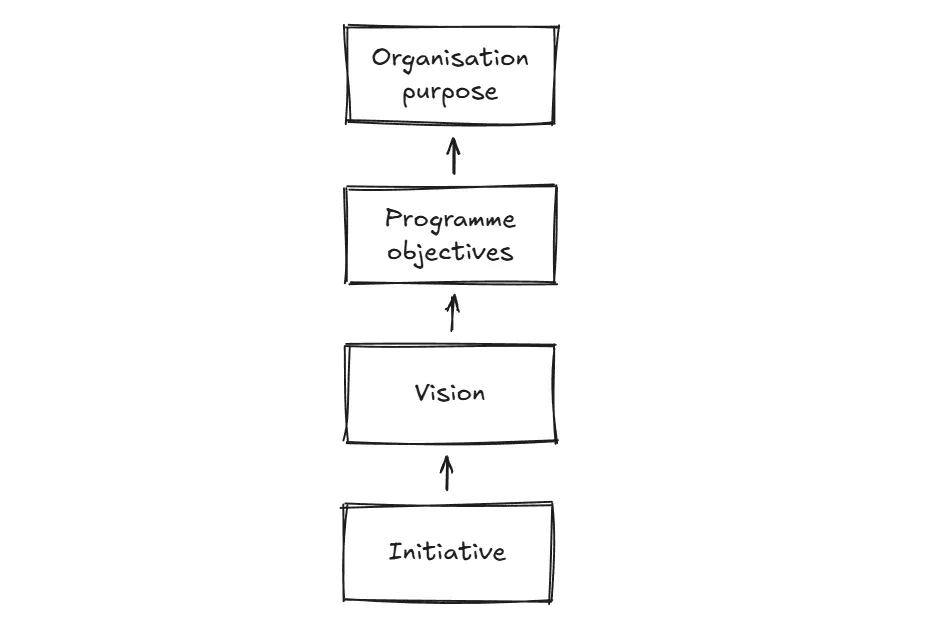
Add or remove layers as your context demands. Some organisations (particularly in the public sector) have more layers than others. For example, a local council might ladder through a service area, directorate, corporate plan, and community strategy. Central government might go through a programme, departmental objectives, ministerial priorities, all the way to manifesto commitment.
The actual structure matters less than attempting the exercise. Can you trace a clear line from this specific piece of work to the reason your organisation exists?
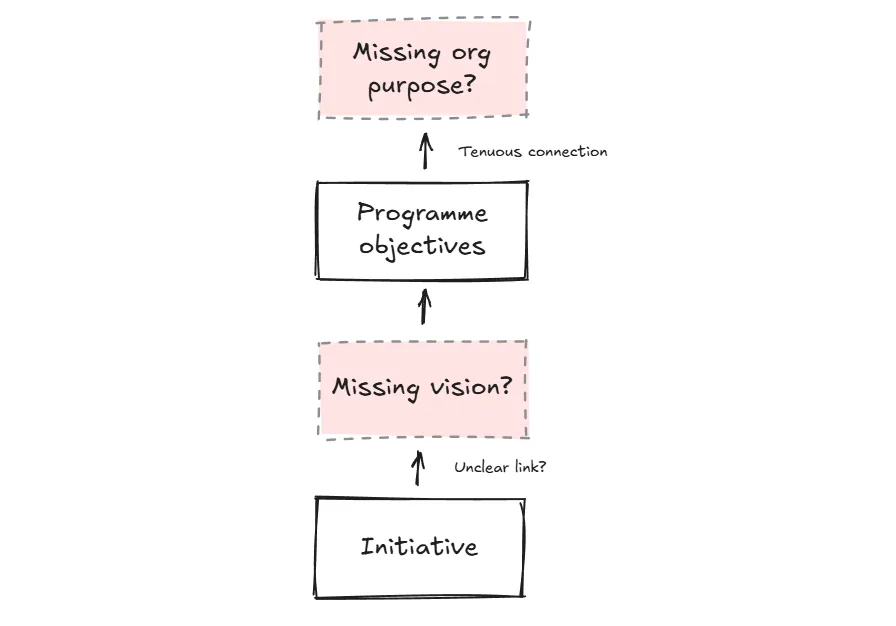
Are the rungs clear?
This is a useful test of whether work actually matters.
If you can't make the connection, how can you expect your team or stakeholders to? If the ladder has missing rungs or requires huge and tenuous links, then you need to think carefully about it's priority.
You might be thinking, "Well, how do I get the data / evidence to establish the link?"
My approach would be to just build the ladder with what you know. It's better to have a rough hypothesis you can test, than to not start at all. If it doesn't hold up under scrutiny, that's useful information.
An example:
Let's say you look after a product for a government department that provides support to people. You need to rebuild a series of pages on your front-end using a new framework (the existing one is out of support).
Fairly dry work - you probably have it filed mentally as "refactoring" or "tech debt".
But, if we do a bit of laddering:
- Initiative: Rebuild staff portal front-end in modern, accessible framework
- Product vision: Provide reliable information to staff when they need it
- Programme goals: Change the nature of how customers and staff interact (less manual processing, digital first approach)
- Directorate mission: Build and support digital tooling that empowers staff to do their jobs
- Organisation purpose: Support society's most vulnerable
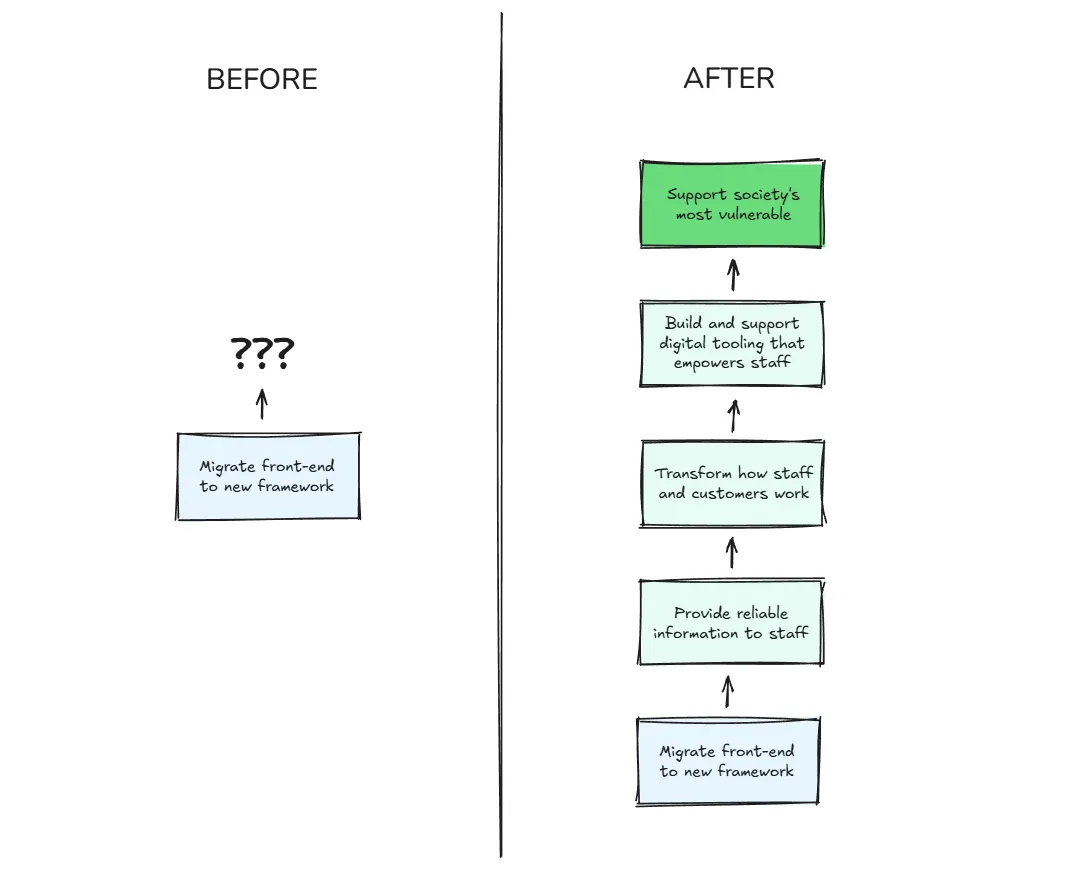
All of a sudden, the boring refactor isn't just technical debt. It's a critical part of the tooling and infrastructure that helps staff support vulnerable people.
The work hasn't changed, but your ability to articulate why it matters has.
Why this helps
Laddering has four benefits I've seen play out consistently:
- Confidence. You know why the work matters, and that comes across in every decision you make and every conversation you have. When you can see the path from initiative to purpose, you stop second-guessing yourself.
- Clarity. Your stakeholders can see the connection too. When someone asks "why are we doing this instead of that?" you have an answer that goes beyond "it's on the roadmap." You can show how this work serves a wider purpose.
- Prioritisation. You can compare apples to apples. When everything ladders up the same way, it's easier to see which initiatives have the strongest, most direct connection to what matters.
- Purpose. The biggest impact I've seen from laddering is how it engages delivery teams: they get clarity on how their work serves real people.
Try it out: start with one initiative
Pick something on your roadmap right now - something that feels important but hard to explain - and have a go at building a ladder.
Then, see whether the rungs hold. Good luck!